Total Pageviews

Saturday, November 16, 2013

And the Debate Continues


I regret that Mr. Feduccia, the general manager for OCP's Spirit and Song division, was upset because of my previous post.  My posting his email was not meant to cause him embarrassment; however, if one is involved in publishing music that is meant for use in the Holy Sacrifice of the Mass, there is a demand for accountability.  The "emperor's new clothes" are not necessarily new.  In fact, as the boy in the fable pointed out, they aren't even clothes at all.

The reason why I chose to make this a public discourse is precisely because, at some point, OCP needs to be held accountable for what is produces.  It seems to me that we are more concerned about the "trans fat" affecting our diets than about the issues affecting the Holy Sacrifice of the Mass, which should be our greater worry.  This debate needs to be out in the open.  I apologize if this forum offended him; it was certainly not my intention.

In fairness to Mr. Feduccia, here is my own response to him. It is lengthy because I have quoted the appropriate sources to answer the points that he made in his email.

========================================================================


Dear Mr. Feduccia:

I regret that my posting your remarks on my blog upset you; however, the response that you gave me is similar to previous conversations that I have had with OCP.

You did not address the concerns that I had, which, interestingly enough, are being shared by bishops who responded to the Lineamenta that the Holy See sent out in preparation for the 2005 Synod on the Eucharist.  The Synod Fathers and the bishop-respondents clearly noted that there were issues with the kinds of music used at “Youth Masses”.  The genre that both they and I referenced, seems to me, is one and the same with that of Spirit and Song.

You noted that you were "befuddled" that the priests who have come into their vocation through LifeTeen are now rejecting the music (e.g. Spirit and Song) that they encountered while part of that movement.  Perhaps it could be because, in their studies in the seminary, these priests realized that this particular genre is not conducive to the sacred nature of the Holy Sacrifice of the Mass.  It may work well for settings outside of the sacred liturgy, but, not for the Mass itself.  Pope Emeritus Benedict XVI made this point in Sacramentum Caritatis, No. 42, which I quoted in my initial correspondence to you.

With all due respect, even the citations from the GIRM and Sacrosanctum Concilium do not make your point.  I believe that the inculturation that SC refers to is more applicable to the scenario that you presented from your visit to Africa than it would for youth.   Even Blessed John Paul II, who founded World Youth Day, voice caution in citing inculturation.  In his Chirograph on Sacred Music, issued two years before his death, the Supreme Pontiff wrote that:

6. The music and song requested by the liturgical reform - it is right to stress this point - must comply with the legitimate demands of adaptation and inculturation. It is clear, however, that any innovation in this sensitive matter must respect specific criteria such as the search for musical expressions which respond to the necessary involvement of the entire assembly in the celebration and which, at the same time, avoid any concessions to frivolity or superficiality. Likewise, on the whole, those elitist forms of "inculturation" which introduce into the Liturgy ancient or contemporary compositions of possible artistic value, but that indulge in a language that is incomprehensible to the majority, should be avoided. 
In this regard St Pius X pointed out - using the term universal - a further prerequisite of music destined for worship: "...while every nation", he noted, "is permitted to admit into its ecclesiastical compositions those special forms which may be said to constitute its native music, still these forms must be subordinate in such a manner to the general character of sacred music, that nobody of any nation may receive an impression other than good on hearing them"[16]. In other words, the sacred context of the celebration must never become a laboratory for experimentation or permit forms of composition and performance to be introduced without careful review.


Regarding musicality, Blessed John Paul II also made some very strong observations, along the same vein as both his successor, Pope Emeritus Benedict XVI and his predecessors, Pope St. Pius X and Pope Paul VI, when he noted that:

4. In continuity with the teachings of St Pius X and the Second Vatican Council, it is necessary first of all to emphasize that music destined for sacred rites must have holiness as its reference point:  indeed, "sacred music increases in holiness to the degree that it is intimately linked with liturgical action"[11]. For this very reason, "not all without distinction that is outside the temple (profanum) is fit to cross its threshold", my venerable Predecessor Paul VI wisely said, commenting on a Decree of the Council of Trent[12]. And he explained that "if music - instrumental and vocal - does not possess at the same time the sense of prayer, dignity and beauty, it precludes the entry into the sphere of the sacred and the religious"[13]. Today, moreover, the meaning of the category "sacred music" has been broadened to include repertoires that cannot be part of the celebration without violating the spirit and norms of the Liturgy itself. 
St Pius X's reform aimed specifically at purifying Church music from the contamination of profane theatrical music that in many countries had polluted the repertoire and musical praxis of the Liturgy. In our day too, careful thought, as I emphasized in the Encyclical Ecclesia de Eucharistia, should be given to the fact that not all the expressions of figurative art or of music are able "to express adequately the mystery grasped in the fullness of the Church's faith"[14]. Consequently, not all forms of music can be considered suitable for liturgical celebrations. 
5. Another principle, affirmed by St Pius X in the Motu Proprio Tra le Sollecitudini and which is closely connected with the previous one, is that of sound form. There can be no music composed for the celebration of sacred rites which is not first of all "true art" or which does not have that efficacy "which the Church aims at obtaining in admitting into her Liturgy the art of musical sounds"[15].

Furthermore, the citation from the GIRM clearly states that the default music for the Church is found in the Introit and the Antiphons, something that OCP has never taken into consideration.  There is no need to have a book featuring 200 songs when the Church has already given us the Gradual Roman, which OCP, in my opinion, continues to ignore.

You indicated that the USCCB document, Sing to the Lord, served as the reference point for Spirit and Song.  However, the document seems to be more suggestive than regulatory in nature.  Even that document, which was never sent to the Holy See for the necessary recognitio, had to be corrected because it encouraged adding additional tropes to the Agnus Dei, even though Sacrosanctum Concilium, which you yourself quoted in your correspondence to me, prohibits anyone from making additions to the sacred texts of the liturgy. Certainly, Sing to the Lord is binding when it quotes and emphasizes existing law; however, to base one's liturgical programming simply on that document, while ignoring what the Holy See has extensively written (including what Popes have officially stated) is to fail to perform due diligence.

With regard to active participation, I believe that there seems to be a well-meaning, but, misguided, interpretation on your part.  I was privileged to hear Malcolm Cardinal Ranjinth address the Gateway Liturgical Conference in 2008 when I was in St. Louis, Missouri.  At the time, he was an archbishop and Secretary to the Congregation for Divine Worship and the Discipline of the Sacraments.  He noted that there is a false perception of what "actuosa participatio" means.

The pope (Benedict XVI), in his book The Spirit of the Liturgy, defines actuosa participatio as a call to a total assimilation in the very action of Christ the High Priest. It is in no way a call to activism, a misunderstanding that spread widely in the aftermath of Sacrosanctum Concilium. Stated Cardinal Ratzinger: “what does it [active participation] mean...? Unfortunately the word was very quickly misunderstood to mean something external, entailing a need for general activity, as if as many people as possible, as often as possible, should be visibly engaged in action” (The Spirit of the Liturgy, 2000, San Francisco: Ignatius Press, p. 171). 
We know that in many places this led to the amalgamation of the sanctuary with the assembly, the clericalization of the laity and the filling up of the sanctuary with the noisy and distracting presence of a large number of people. One could say that virtually Wall Street moved into the sanctuary. But was that really what the Council Fathers advocated? Cardinal Ratzinger does not think so. For him, “the real ‘action’ in the liturgy in which we are all supposed to participate is the action of God Himself. This is what is new and distinctive about Christian liturgy: God Himself acts and does what is essential” (ibid, p. 173). 
This kind of participation in the very action of Christ, the High Priest, requires from us nothing less than an attitude of being totally absorbed in Him. Says the cardinal “the point is that, ultimately, the difference between the actio Christi and our own action is done away with. There is only one action, which is at the same time His and ours — ours because we have become ‘one body and one spirit ‘with Him” (ibid p. 174).
Active participation, thus, is not a giving way to any activism but an integral and total assimilation into the person of Christ who is truly the High Priest of that eternal and uninterrupted celebration of the heavenly liturgy. 
The Council’s Constitution on the Liturgy, Sacrosanctum Concilium, too, as we know, spoke of this when it defined liturgy further as a foretaste of the “heavenly liturgy which is celebrated in the Holy City of Jerusalem towards which we journey as pilgrims, and in which Christ is sitting at the right hand of God, a minister of the sanctuary and of the true Tabernacle” (cf. Rev. 21:2; Col. 3:1; Heb. 8:2)-(SC 8). 
Hence, everything we do should help us to achieve that and that alone is the true meaning of the “participatio”: a taking part in a bigger actio. Participatio itself is, I would say, in this sense, an ars [art] where we ourselves are not the artists; neither do we follow an art taught or handed down to us by others, but allow the Lord to be the artist through us, becoming part of what He does. As far as we are concerned, it is participatio in the order of “esse” — being. All that we do in liturgy makes us achieve that union with the eternal high priest, Christ and His sanctifying offering. The more we become part of the oratio of Christ, His eternal self-offering to God as the expiatory Sacrificial Lamb (Rev. 14:1-5), so much more would it be able to transform us into the Logos and make us experience the redeeming effects of such a transformation. Without that, as Cardinal Ratzinger wrote, we would radically misunderstand the “theo-drama” of the liturgy, lapsing into mere parody (cf. ibid p. 175).

In other words, one can actively participate in the Holy Sacrifice of the Mass by uniting oneself with the prayers that are chanted (Introits and Antiphons).  Actuosa Participatio is not confined to vocal nor physical activity. I have experienced this first hand whenever I have been at a Mass where the Propers are chanted.  I may not know the melody, but, I can unite myself to these prayers.  In fact, even when I have gone to Masses at Our Lady of Walsingham Church, the Oridinariate Parish in Houston, the chants used are quite conducive to prayer that they foster a sense of the divine, encouraging interior prayer.  This is also quite true in the chanting of the Propers in Latin during the Papal Masses. These chants, regardless of the language, set a sacred tone to the Mass because they signal to us that Something, Someone greater than ourselves is present. Spirit and Song, in my opinion, fails, lamentably, to do this.  This is perhaps why the priests who were formally a part of LifeTeen when they were adolescents are now rejecting this particular genre of music.

I realize that this is a lengthy response; however, in charity, I am compelled to point out these things that I believe OCP fails to take into account, not only in Spirit and Song, but in its other collections, most notably, Flor y Canto.  OCP carries an obligation to adhere to the Church documents and to produce sacred music that "respects the meaning of the liturgy (Sacramentum Caritatis 42)" so that such "correspond(s) to the meaning of the mystery celebrated, the structure of the rite and the liturgical seasons."

With all due respect, Spirit and Song does not live up to this test.  In the end, both the liturgy and the youth are cheated out of proper liturgical music.

Respectfully submitted,
Michelle Marie Romani

Friday, November 15, 2013

No Reply at All


I sent my previous post, "Shadows and Fog", in the form of an email, to OCP's Spirit and Song division.  Inasmuch as I wanted to receive a response from Ken Canedo, I heard back from Robert Feduccia, the General Manager for Spirit and Song.

The response left me somewhat befuddled.  It reminded me of that old Genesis song from the 1980s, "No Reply at All."   Below, is the text of his email.  I leave it to you, dear reader, to assess the situation.  In a subsequent post, I will lay out my response to him.

Hi Michelle:

I do not wish to dismiss you. You obviously love the Church and you obviously love our Lord. As a disciple, I want to first thank you and say to you that what binds us in unity, the Eucharist and the Universal pastor, is greater than anything that divides us, liturgical music. 

The documental footing that we stand on is Sacrosanctum conciliumGeneral Instruction on the Roman MissalSing to the Lord.

First to set the tone, the Roman Missal has a two-fold characteristic. It is Roman and imbued with Roman Culture. For example, Gregorian Chant is proper to the Roman liturgy just as Byzantine chants are proper to the Divine Liturgy of St. John Chrysostom. It is for this reason that the Church rightly preserves that which is proper to the liturgy. As the General Instruction on the Roman Missalstates it's first two of four options for music at the liturgy:

(1)  the antiphon from The Roman Missal or the Psalm from the Roman Gradual as set to music there or in another musical setting
(2)  the seasonal antiphon and Psalm of the Simple Gradual
These options are there to preserve the patrimony of the Roman Rite.
The uniquely Roman character proper to the Roman Missal is the first characteristic. The second characteristic of the Roman Rite is that it is a universal rite. It functions as both the Roman Missal and the Missal for the Universal Church. It for this reason that the General Instruction on the Roman Missal provides the next two options for music:
(3)  a song from another collection of psalms and antiphons, approved by the Conference of Bishops or the diocesan Bishop, including psalms arranged in responsorial or metrical forms
(4) a suitable liturgical song similarly approved by the Conference of Bishops or the diocesan Bishop.

The Church provides other options for music besides that which is proper to the Roman Missal as she says in the General Instruction on the Roman Missal:
“All other things being equal, Gregorian chant holds pride of place because it is proper to the Roman Liturgy. Other types of sacred music, in particular polyphony, are in no way excluded, provided that they correspond to the spirit of the liturgical action and that they foster the participation of all the faithful.”

The two paramount requirements are 1) the fully conscious and active participation of the faithful 2) correspondence to the spirit of the liturgical action.
Please know, that understand the issue you have is the stylistic nature of contemporary music. It is not whether or not the lyrical content corresponds. It is, by it's very nature, the music does not correspond. I do understand that and I'm getting there :-) I just want to lay out the linear nature of our thought.
The fully conscious and active participation of the faithful requires prayer and song. Sacrosanctum concilium states in paragraph 7 “Praesens adest denique dum supplicat et psallit Ecclesia …” The English the translation is that Christ is present when the Church (supplicat) prays and (psallit) sings. As an aside, the Latin verb for sing in this paragraph literally means to sing to an accompanied plucked instrument. That's not part of my argument, but I do find it interesting. My point is this. There is a presence of Christ that is called for by the dogmatic constitution that is dependent upon people's prayer and people's singing, their prayerful singing. It is a very pragmatic requirement.

Prayerful singing that corresponds to the spirit of the liturgical action is the focus of everything we do. Again, the Roman Rite is both Roman and Universal. The General Instruction on the Roman Missal say, "All other things being equal, Gregorian chant holds pride of place because it is proper to the Roman Liturgy." The unstated question is, "Equally does what?" The answer is, "Equally leads to the participation of all the faithful." There are many who are trying to raise the dignity of chant in order for it to be on equal footing as other forms of sacred music as described by General Instruction on the Roman Missal. I do not believe it is as we talk today. I also would not be of the opinion that we should stop the publication of other forms of sacred music. 

To speak anecdotally for moment, the number of vocations that have come from the Life Teen movement is staggering. As a movement, they have fostered an unparalleled love for the authentic and orthodox teaching of the Church within the young people they serve. I must admit I get befuddled by the number of priests who are against the use of contemporary music despite the fact that their own evangelization came through the use of such contemporary music during praise and worship, Eucharistic adoration, and at the liturgy itself.

But back to the doctrinal sources, Sacrosanctum concilium 37-39 states the following:

D) Norms for adapting the Liturgy to the culture and traditions of peoples
37. Even in the liturgy, the Church has no wish to impose a rigid uniformity in matters which do not implicate the faith or the good of the whole community; rather does she respect and foster the genius and talents of the various races and peoples. Anything in these peoples' way of life which is not indissolubly bound up with superstition and error she studies with sympathy and, if possible, preserves intact. Sometimes in fact she admits such things into the liturgy itself, so long as they harmonize with its true and authentic spirit.
38. Provisions shall also be made, when revising the liturgical books, for legitimate variations and adaptations to different groups, regions, and peoples, especially in mission lands, provided that the substantial unity of the Roman rite is preserved; and this should be borne in mind when drawing up the rites and devising rubrics.
39. Within the limits set by the typical editions of the liturgical books, it shall be for the competent territorial ecclesiastical authority mentioned in Art. 22, 2, to specify adaptations, especially in the case of the administration of the sacraments, the sacramentals, processions, liturgical language, sacred music, and the arts, but according to the fundamental norms laid down in this Constitution.

Such cultural considerations are vital to the work of evangelization. This is particularly true in missionary lands, but it is also true in our land, the land of the New Evangelization. It is for this reason that we at Spirit & Song see ourselves as a ministry of the New Evangelization. Our Roman Missal is Roman and is to preserve the Roman patrimony. It is also Universal and adaptable according to the pastoral need of the people. It is for this reason that Sacrsanctum concilium upholds the entrance of art, music and customs from the local culture. I was recently in Africa and experienced the power of the Roman Rite accompanied by drums and dancing. That certainly looks profane to the Western eye, but this aided the Church's work in evangelization in Ghana. The Roman Rite allows such flexibility and adaptation.

The definition of that which is profane lies, according to Sacrasanctum concilium 22, with the territorial episcopal authority: 
22. 1. Regulation of the sacred liturgy depends solely on the authority of the Church, that is, on the Apostolic See and, as laws may determine, on the bishop.
2. In virtue of power conceded by the law, the regulation of the liturgy within certain defined limits belongs also to various kinds of competent territorial bodies of bishops legitimately established.
3. Therefore no other person, even if he be a priest, may add, remove, or change anything in the liturgy on his own authority.

Our territorial body is the United States Conference of Catholic Bishops and their document, Sing to the Lord, serves our nation as the guidepost for music in the liturgy. They recognize the tension in which we live, the tension between the preservation of the Roman Rite's patrimony and the pastoral nature of the liturgy. That pastoral nature includes the work of evangelization. We see that Spirit & Song is able to aid in the work of evangelization and that the songs, even in their style that considers the local music as allowed by SC 39, has the ability to draw people into prayerful participation that is demanded by the sacred liturgy.

Blessings to you!
Robert Feduccia, general manager Spirit & Song

The reply really did not address anything.  It seemed to me that he completely ignored the issue raised by the Fathers of the 2005 Synod on the Eucharist when they wrote their concerns about the music used during “Youth Masses.”   As I indicated earlier, I will, in a subsequent post, put forth my reply to Mr. Feduccia.

Monday, November 11, 2013

Shadows and Fog


A few days ago, I got into somewhat of a Twitter disagreement with one of the OCP composers, Ken Canedo, who is, from what I understand, responsible for the Spirit and Song collection.  I regret that I used the term "wrecking ball" when referencing the composition.  Mr. Canedo took exception to it, saying that I was "nasty"; however, when I sent him subsequent tweets and links to the blog (with citations from the authoritative documents of the Holy See to back my points) to better explain my position, he never responded.

I certainly do not want to engage in a Twitter battle with him nor anyone else; however, if we confine our arguments to simple expressions of feelings and sentiments without stepping back and examining the bigger picture, then we cannot engage in any kind of a dialogue.  I encountered the same problem with Mark Hart, one of the national leaders from the LifeTeen movement. Rather than address my points, his team sent me a link to a talk given by a "conservative" priest who had "seen the light" about using contemporary Praise and Worship music for the Mass.  Neither Mark nor the priest (nor the LifeTeen staff, for that matter), quoted any of the documents from the Congregation for Divine Worship to justify their vehement support.  The commentary seemed to me to be based on feelings.

In 2004, when Blessed John Paul II wrote his last encyclical, "Ecclesia de Eucharistia", he observed that there were shadows that have creeped into the Mass, shadows that needed to be dispelled.  In preparation for the 2005 Synod on the Eucharist, the Holy See prepared a set of questions that were submitted to the bishops from around the world (both Latin and Eastern Rites), the prefects of various Roman Congregations and Superiors General of the religious orders.  One such question centered around the issue that Polish Pontiff had addressed:

4. The Shadows in the Celebration of the Eucharist: In the Encyclical Letter Ecclesia de Eucharistia (n. 10) the Holy Father mentions "shadows" in the celebration of the Eucharist. What are the negative aspects (abuses, misunderstandings) existing in Eucharistic worship? What elements or actions done in practice can obscure the profound sense of the Eucharistic mystery? What is the cause of such a disorienting situation for the faithful? 

Also in that same Lineamenta, the document brings up the issue of the music used during the Holy Sacrifice of the Mass.  It notes that:


The Dignity of Chant and Sacred Music51. Chant and music ought to be worthy of the mystery which is celebrated, as seen in the psalms, hymns and spiritual canticles of Sacred Scripture. (cf. Col 3:16) Therefore, from the first centuries, the Church has considered sacred music as an integrating part of the Liturgy. While embracing various musical forms, the Church’s Magisterium has constantly emphasised that “various forms of music be consistent with the spirit of the Sacred Liturgy”,190 so as to avoid the risk that divine worship might be adversely affected by unsuitable profane elements.

This fact seems to be lost on Ken Canedo, Mark Hart and adherents of the Spirit and Song collection. Inasmuch as OCP has now come up with a supposedly new and improved version of the book, I do not know if the publishing house took to heart the concerns that the Fathers of the 2005 Synod on the Eucharist expressed in the Instrumentum Laboris 


62. Some responses particularly mentioned the use of musical instruments, referring to the general guidelines contained in the Constitution Sacrosanctum concilium.89 In this regard, a certain appreciation was often voiced in the Latin tradition for the organ, whose majestic sound adds solemnity to worship and is conducive to contemplation. Some responses also made reference to experiences associated with the use of other musical instruments in the liturgy. Positive results in this area were achieved with the consensus of competent ecclesiastical authority, who judged these instruments proper for sacred use, in keeping with the dignity of the place and the edification of the faithful. 
In other responses some lamented the poor quality of translations of liturgical texts and many musical texts in current languages, maintaining that they lacked beauty and were sometimes theologically unclear, thereby contributing to a weakening of Church teaching and to a misunderstanding of prayer. A few responses made particular mention of music and singing at Youth Masses. In this regard, it is important to avoid musical forms which, because of their profane use, are not conducive to prayer. Some responses note a certain eagerness in composing new songs, to the point of almost yielding to a consumer mentality, showing little concern for the quality of the music and text, and easily overlooking the artistic patrimony which has been theologically and musically effective in the Church’s liturgy.

This is an area of concern that neither Mr. Canedo, Mr. Hart nor OCP has ever addressed. Mr. Canedo was noting about how excited he was to play his guitar at St. Peter's Basilica.  That is all well and good; however, an entirely different matter is coming up with music that does not sound like something that one would hear on a secular easy listening station nor on a Broadway stage.  

When he wrote his Apostolic Exhortation in response to the Synod on the Eucharist in 2007, Pope Emeritus Benedict XVI echoed the concerns that the Synod Fathers shared about the question of music in the liturgy.  I have often quoted this on numerous occasions in this blog; however, it bears repeating:


Liturgical song 
42. In the ars celebrandi, liturgical song has a pre-eminent place. (126) Saint Augustine rightly says in a famous sermon that "the new man sings a new song. Singing is an expression of joy and, if we consider the matter, an expression of love" (127). The People of God assembled for the liturgy sings the praises of God. In the course of her two-thousand-year history, the Church has created, and still creates, music and songs which represent a rich patrimony of faith and love. This heritage must not be lost. Certainly as far as the liturgy is concerned, we cannot say that one song is as good as another. Generic improvisation or the introduction of musical genres which fail to respect the meaning of the liturgy should be avoided. As an element of the liturgy, song should be well integrated into the overall celebration (128). Consequently everything – texts, music, execution – ought to correspond to the meaning of the mystery being celebrated, the structure of the rite and the liturgical seasons (129). Finally, while respecting various styles and different and highly praiseworthy traditions, I desire, in accordance with the request advanced by the Synod Fathers, that Gregorian chant be suitably esteemed and employed (130) as the chant proper to the Roman liturgy (131).

The whole Spirit and Song/LifeTeen approach to music in the Mass, in my opinion, fails to live up to the parameters established by Sacramentum Caritatis 42.  When I pointed this out to Ken Canedo, he never responded.  When I have pointed this out to staff from both GIA and OCP, they told me that this was simply my opinion and dismissed it.  Even the new version of Spirit and Song has still not quite gotten up to par with SC 42.  Inasmuch as composers like Matt Maher were popular at this year's World Youth Day, that does not mean that their particular style of music is fitting for the Mass.  In its website, OCP touts the fact that they consulted with young adults and youth ministers to find music that engages this group in ages.  It also states that they consulted with Catholic theologians to ensure that the content is theologically sound.  That is all well and good; however, the musical genre (the musicality, if you will) continues to fail to respect the meaning of the liturgy.

Interestingly enough, there is a growing movement within the youth, a yearning, if you will, for the sacred.  This is evidenced by the increasing number of members of the Juventuum Movements that are springing up worldwide.  These young people hunger for the sacred and want to experience Something beyond themselves.  They are finding it at Juventuum.

OCP still has a chance to dispel the shadows that exist in the liturgy by improving the quality of the music the house produces for the Mass.  The youth, OCP's target audience, years for the Sacred.  The Holy Sacrifice of the Mass, by its very nature, demands the Sacred.  It is part of the Church's heritage and it should not be cast out into the darkness.

Sunday, November 3, 2013

Just Who Is the Church


When we talk about the Church, we tend to think about the warm living bodies that occupy the pews on any given Sunday.  We address issues such as religious education for children and adults, various parish activities and other events that involve the larger diocesan family.

However, if we merely confine our definition of the Church, to those who are presently on this Earth, we fail to see the big picture.  Every November, the Church reminds us that there are two very concrete realities that we must consider insofar as just who makes up the complete Body of Christ.  Those of us us who are breathing make up the Church Militant. We are the ones who are still down in the trenches waging the day-to-day battle against sin and temptation.  But, it's not just about us.  On November 1st and November 2nd, the Church calls to mind two other members of her family, the Church Triumphant (the Saints in heaven) and the Church Suffering (the Holy Souls in Purgatory). While we do not physically see these two groups, they remain an integral part of the People of God.  They are part of the Church and they are part of us.  We are united to them and they to us by the bond of love, a yoke that will never be broken.  That is what it means to be a part of the Communion of Saints.

All three components of the Church, Triumphant, Militant and Suffering, come together during every celebration of the Holy Sacrifice of the Mass.  The Prefaces of the Eucharistic Prayers remind us that our voices join the unending choruses of the angels and saints as we chant the Sanctus.  At every Mass, the veil between heaven and earth and time and space is lifted.  We are not alone as we are joined by a cloud of unseen witnesses, as St. Paul reminds us, who unite their sublime praises to ours.  During the Memorial of the Eucharistic Prayer, we pray for and with the souls in Purgatory, as we ask God to look upon them in His great mercy so that they, too, will receive "kind admittance" into His Kingdom, just as St. Dismas did.

Sadly, we may often be too caught up in trying to make the Mass more creative that we do not take into account the divine, heavenly reality that transpires at every liturgy.  We try to look for music to make the Mass more relevant to us instead of helping the earthly liturgy be more reflective of the sublime nature of the divine one.

Maybe this is one of the things that Pope Emeritus Benedict XVI meant to convey when he called for a mutual enrichment between the Extraordinary and Ordinary Forms of the Mass.  In the Extraordinary Form, the awareness of the unity of the Church (Triumphant, Militant and Suffering) seems more apparent with both the texts of the prayers and the music.  There seems to be an other-ness to the liturgy, a sense that something greater than ourselves is happening.  This is not to say that one cannot get the same sense in the Ordinary Form of the Mass; however, it can be difficult when one uses substandard music such as "Table of Plenty", "I am the Light of the World", "Rain Down" and "Gather Us In" or crafts General Intercessions that sound more like political statements than prayers.  When things like that happen, we focus on ourselves, thinking we are the only ones in the Church, instead of recognizing that we just make up two-thirds of the Body of Christ.

Yet, the Church Triumphant and the Church Suffering still pray with and for us.  They remain in union with us even when we forget that they are there.  We are not alone.

Saturday, November 2, 2013

The Propers are Proper!


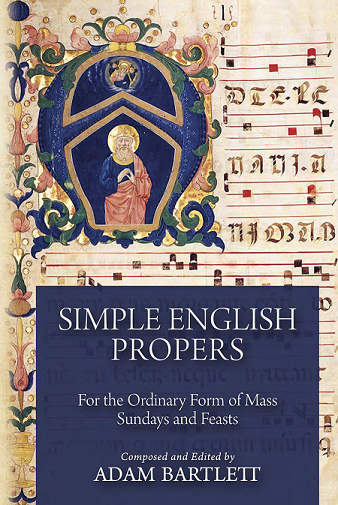
For the Solemnity of All Saints Day, I was privileged to cantor at two different parishes, my maternal ancestral parish for the Vigil and my own parish for the actual day.  I used the Introit and Communion Antiphon from Adam Bartlett's magnificent opus, Simple English Propers.

As someone who does not read any kind of musical notation, I found these settings to live up to the name and more.  The online tutorials provided by the Church Music Association of America, both on YouTube and Vimeo, made following the tune and the text quite easy.

On a deeper level, the Simple English Propers allows for one to both sing the Mass and pray the Mass.  Often, those in charge of music for the Holy Sacrifice of the Mass review hymns trying to determine which piece "fits" the liturgy.  What one might fail to realize is that the Church has already given us the music and the text for just about any given Mass.    Let's look at the Introit for the Solemnity of All Saints:


The sacredness of the chant, coupled with the text of the Introit, which comes to us from the Roman Gradual, sets the tone that something extraordinary is beginning.  It conveys the sense of the divine act more clearly than a hymn.  In fact, if we look at the General Instruction of the Roman Missal, this is certainly the intent of the Church:

The Entrance47. When the people are gathered, and as the Priest enters with the Deacon and ministers, the Entrance Chant begins. Its purpose is to open the celebration, foster the unity of those who have been gathered, introduce their thoughts to the mystery of the liturgical time or festivity, and accompany the procession of the Priest and ministers. 
48. This chant is sung alternately by the choir and the people or similarly by a cantor and the people, or entirely by the people, or by the choir alone. In the Dioceses of the United States of America, there are four options for the Entrance Chant: (1) the antiphon from the Missal or the antiphon with its Psalm from the Graduale Romanum, as set to music there or in another setting; (2) the antiphon and Psalm of the Graduale Simplex for the liturgical time; (3) a chant from another collection of Psalms and antiphons, approved by the Conference of Bishops or the Diocesan Bishop, including Psalms arranged in responsorial or metrical forms; (4) another liturgical chant that is suited to the sacred action, the day, or the time of year, similarly approved by the Conference of Bishops or the Diocesan Bishop. 
If there is no singing at the Entrance, the antiphon given in the Missal is recited either by the faithful, or by some of them, or by a reader; otherwise, it is recited by the Priest himself, who may even adapt it as an introductory explanation (cf. no. 31).

The Introit, Antiphon, if you will, is the default music of the Church.  It constitutes the liturgical prayer of the Church as found in the Roman Gradual.  Sadly, the fourth option, the use of hymns, has taken over the rightful place of the Propers.  In some parishes, for example, "Table of Plenty" usurped the Introit for All Saints Day.  Inasmuch as the theology of that particular song is somewhat suspect and the musicality is not quite sacred, the idea that it would stand in for something that is part of the Church's liturgical treasury makes no sense.  

The same holds true for the Communion Antiphon, which is supposed to begin as the celebrant consumes the Sacred Species.  Here is the Communion Antiphon from the Simple English Propers:

Communion Antiphon All Saints Day


B lessed are the pure in heart, for they shall see
God; * blessed are the peacemakers, for they shall be called
sons of God; blessed are those who suffer persecution for
the sake of justice, for theirs is the kingdom of hea-ven.


While there are modern settings of the Beatitudes (Blest are They), these do not contain the corresponding Psalm 126(125). The musicality of the modern hymns also does not lend itself to the sacred nature of the Communion Chant.  Again, we turn to the GIRM for guidance:


87. In the Dioceses of the United States of America, there are four options for singing at Communion: (1) the antiphon from the Missal or the antiphon with its Psalm from the Graduale Romanum, as set to music there or in another musical setting; (2) the antiphon with Psalm from the Graduale Simplex of the liturgical time; (3) a chant from another collection of Psalms and antiphons, approved by the Conference of Bishops or the Diocesan Bishop, including Psalms arranged in responsorial or metrical forms; (4) some other suitable liturgical chant (cf. no. 86) approved by the Conference of Bishops or the Diocesan Bishop. This is sung either by the choir alone or by the choir or a cantor with the people.
However, if there is no singing, the antiphon given in the Missal may be recited either by the faithful, or by some of them, or by a reader; otherwise, it is recited by the Priest himself after he has received Communion and before he distributes Communion to the faithful.


As with the Introit, the Communion Antiphon is the default music of the Church for this particular moment in the liturgy.  Yet, in the United States, publishing houses promote the fourth option, the usage of hymns, instead of what the Church has already provided for us to use.  The Communion Antiphon forms part of the Church's liturgical prayer.  It is not a mere song.

After yesterday's Mass, someone came up to the celebrant and commented on how different the liturgy was.  She told him that she found the Mass "more prayerful" and that the music seemed to her to set a sacred tone.  The celebrant seemed pleased with the reaction and he noted that it was because the Introit and the Communion Antiphon are the prayers of the Church.

The problem with using hymns is that, more often than not, we wind up with music that has both questionable theology and substandard musicality.  It's more along the lines of what we (or the publishing house) thinks that the theme of the Mass should be.  When this issue came up in the Catholic Answers Liturgy Forum, one of the participants, a parish music director, defended the use of hymns, stating that the USCCB had given the green light for hymns.  However, to cheat the liturgy out of the music that is proper to the Mass constitutes a great disservice to the liturgy.  Furthermore, the manner in which hymns are composed in this day and age turns the liturgy into being at the service of the music instead of the other way around.

Yes, learning the Introit and the Antiphon requires a bit of work, especially if one does not know how to read music; however, we owe it to the integrity of the Holy Sacrifice of the Mass to give it our best.  The fact that the Church Music Association of America has already made tutorial videos makes things a lot easier.

Let us reclaim what is Proper to the Holy Sacrifice of the Mass!

Sunday, October 27, 2013

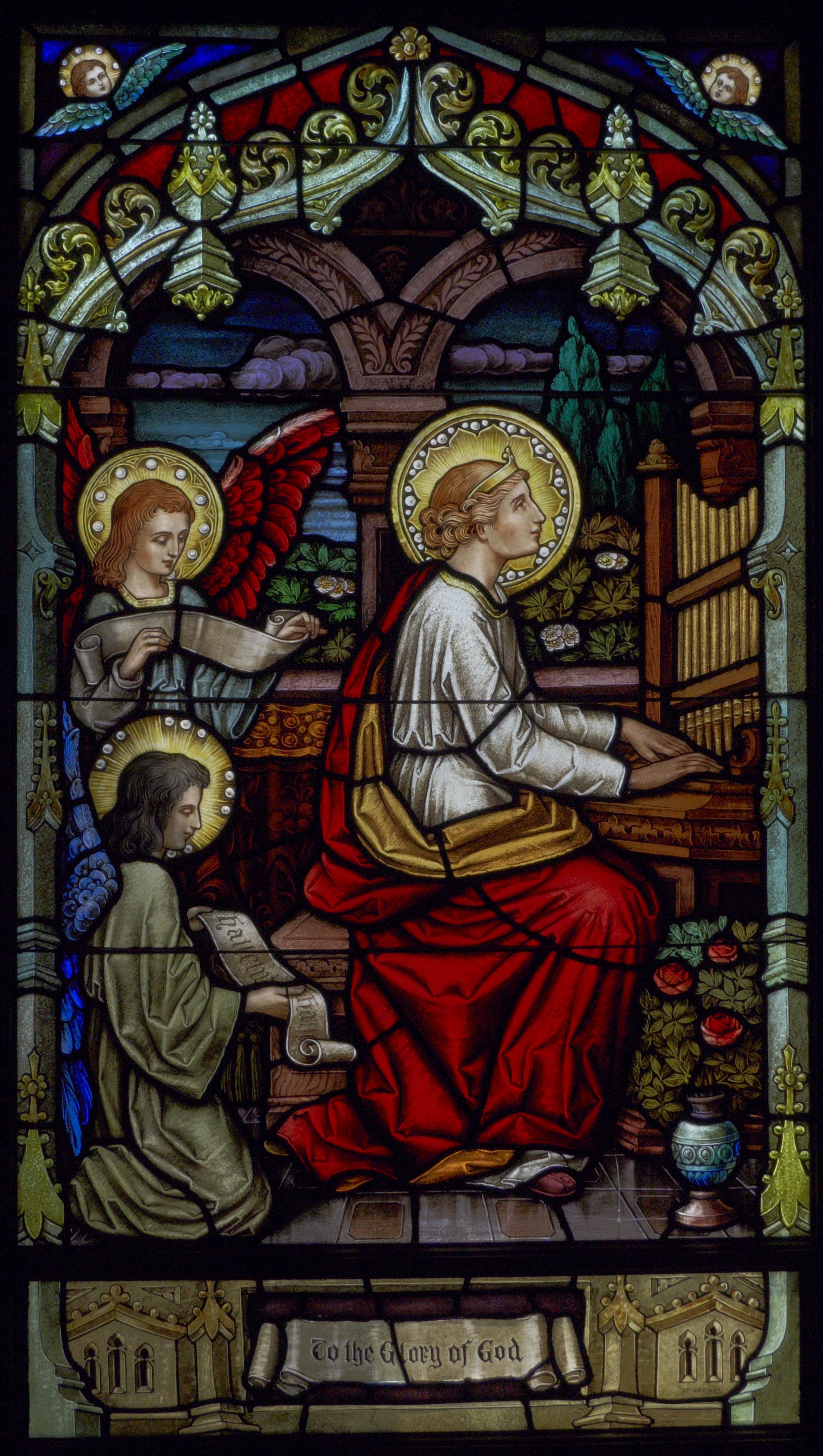
Not Quite Worthy of St. Cecilia


When the Congregation for Divine Worship and the Discipline of the Sacraments released the revised Ordinary of the Mass to the English-speaking bishops conferences, it admonished composers to respect the sacredness of these words when setting them to music.  Composers like Scotsman James MacMillan took this wise counsel to heart when he set the text to music.  ICEL certainly upped the ante by including a chant setting for the revised Ordinary in the Third Typical Edition of the Roman Missal.

Lamentably, however, the CDWDS’s words were lost on the two largest liturgical publishing houses, GIA and Oregon Catholic Press (OCP). In the case of OCP, the publishing house’s much hyped “Misa Santa Cecilia”, which the company promotes as a vibrant bilingual setting with the correct words and approved by the USCCB, the setting, in my opinion, fails to live up to the directive from the CDWDS.

The setting seems to be faithful to the text.  This is certainly good, given OCP’s previous track record of taking liberties with both the English and Spanish texts of the Ordinary of the Mass. However, when it comes to the musicality, something seems to be amiss.

Here is what Sacramentum Caritatis urges musicians to do when composing music for liturgical use:

Certainly as far as the liturgy is concerned, we cannot say that one song is as good as another. Generic improvisation or the introduction of musical genres which fail to respect the meaning of the liturgy should be avoided. As an element of the liturgy, song should be well integrated into the overall celebration (128). Consequently everything -- texts, music, execution -- ought to correspond to the meaning of the mystery being celebrated, the structure of the rite and the liturgical seasons (129).
OCP implies that this bilingual setting celebrates Hispanic culture, calling the piece vibrant.  In fact, when reading through the description, I failed to find any usage of the word sacred.  OCP spent more time focusing on the culture that it failed to take into account the sacred nature of the text, completely ignoring Sacramentum Caritatis 42.

When I listened to the setting, all I could think about was Latin night on Dancing with the Stars.  At any moment, I was expecting Mark Ballas and Cheryl Burke to come out and do a Bolero dance during the Penitential setting and the Agnus Dei, or a Salsa number to the Gloria and the Sanctus. The settings for the Memorial Acclamation could either be a Paso Doble or a Rumba. 

Now, in fairness, I have also heard the setting in three different real-world experiences during Mass.  OCP tends to over-stylize its presentations using instruments that one would not normally encounter during Mass (drums, electric guitars, bass guitars and the like).  In my actual experience with the piece, I heard it on three separate occasions wherein the piano and the guitar were used and then with the organ.  I tried to be objective; however, even if the organist from St. Peter’s Basilica were playing the pieces, it would not change a thing: the composition is just bad.

Even the way the setting treats the wording is somewhat suspect.  When Pope St. Pius X wrote his Motu Propio on Sacred Music, Tra le Sollecitudini, he noted that:

(S)ince modern music has risen mainly to serve profane uses, greater care must be taken with regard to it, in order that the musical compositions of modern style which are admitted in the Church may contain nothing profane, be free from reminiscences of motifs adopted in the theaters, and be not fashioned even in their external forms after the manner of profane pieces.
6. Among the different kinds of modern music, that which appears less suitable for accompanying the functions of public worship is the theatrical style, which was in the greatest vogue, especially in Italy, during the last century. This of its very nature is diametrically opposed to Gregorian Chant and classic polyphony, and therefore to the most important law of all good sacred music. Besides the intrinsic structure, the rhythm and what is known as the conventionalism of this style adapt themselves but badly to the requirements of true liturgical music.
Inasmuch as some may argue that Pope St. Pius X wrote this admonition back in 1903, the problems that plagued the music used in the Church’s liturgy 110 years ago persist today.  Even Blessed John Paul II recognized this issue in 2003, when he wrote his Chirograph on Sacred Music:
12. With regard to compositions of liturgical music, I make my own the "general rule" that St Pius X formulated in these words:  "The more closely a composition for church approaches in its movement, inspiration and savour the Gregorian melodic form, the more sacred and liturgical it becomes; and the more out of harmony it is with that supreme model, the less worthy it is of the temple"[33]. It is not, of course, a question of imitating Gregorian chant but rather of ensuring that new compositions are imbued with the same spirit that inspired and little by little came to shape it. Only an artist who is profoundly steeped in the sensus Ecclesiae can attempt to perceive and express in melody the truth of the Mystery that is celebrated in the Liturgy[34].
OCP devotes so much time to promoting cultural diversity that it forgets the one aspect that sets liturgical music apart from the rest:  it is to be used in the service of the liturgy and not the other way around.  We are not here to celebrate one particular culture, or a mish-mash of cultures, as the late Fr. Richard John Neuhaus passionately lamented when going over the substandard musical selections that Pope Emeritus Benedict XVI was subjected to during the Mass at Nationals Stadium in April 2008.  Before we are anything else, we identify ourselves as Catholic.  Catholic means universal.  We do not splinter off into some cultural Tower of Babel when it comes to our liturgies.  We are supposed to be united as one in prayer. 
This is why bilingual Mass settings ultimately fail.  There is no unity when we split up the Ordinary of the Mass into two different languages.  In fact, Liturgicam Authenticam takes that point into strong consideration:
88. In the case of the Order of Mass and those parts of the Sacred Liturgy that call for the direct participation of the people, a single translation should exist in a given language,67 unless a different provision is made in individual cases.
What is the point, then, of having bilingual settings?  Why not promote the language that unifies all of us as children of the Church: Latin?  Yet, OCP has never offered anything new in Latin.  The publishing house is so busy promoting culture that it fails to realize that Latin is our liturgical heritage.
Then there is the issue of the responsorial Gloria.  This is a recent phenomenon, one that I have not even seen in Latin.  The problems with this type of a setting are that the piece chops up the Gloria, interrupting the flow of the prayer and it also unduly prolongs the introductory rite, turning the music into a performance.  Misa Santa Cecilia is also uses the same repetitive mechanism for the Sanctus and the Agnus Dei.  The latter seems to go into infinity.  It’s a double whammy of a bad piece that never seems to end.
If Spanish language congregations are in need of a setting of the Ordinary that fulfills Sacramentum Caritatis 42 and the prescriptions set forth by Pope St. Pius X, Blessed John Paul II and Liturgicam Authenticam, one need only look at the magnificent composition set forth by Fr. Matthew Spencer.  Fr. Spencer set the Spanish language Ordinary of the Mass using Jubilate Deo, the simple Latin Mass setting promulgated by Pope Paul VI.  One can find it here: http://marello.org/simplex/collections/ordinary-i/
OCP had the chance to promote the sacred and the majestic with its Misa Santa Cecilia.  Unfortunately, it does neither and fails to live up to the dignity of its namesake.


Sunday, October 20, 2013

An Open Letter to Archbishop Alexander Sample


Most Reverend and Dear Archbishop Sample:

Greetings in the name of our Lord, Jesus Christ!

I write this letter to you on behalf of many of us who have a deep regard for the Holy Sacrifice of the Mass and who seek to preserve its sacred nature.  In you, we have found a kindred spirit for you have done much in the way of restoring the sacred, especially where it concerns music, to the liturgies that were celebrated in your previous diocese.

You are now the Archbishop of Portland, which is the home to Oregon Catholic Press.  Many parishes, as you well know, make use of the musical offerings published by this organization.  While there may be some merit to the compositions, the rest, especially those meant for use in Spanish-language parishes, leave much to be desired when it comes to the sacred and have become a parody of what liturgical music is supposed to be.

I brought this to the attention of OCP on several occasions and have never received a suitable response.  Staff told me that it was simply my personal opinion.  When I asked if the composers have read the documents, I received a less than satisfactory reply.  The publishing house had not even heard of the Propers.

Your Excellency, in 2007, when Pope Emeritus Benedict XVI wrote Sacramentum Caritatis, he rightly observed that:


Certainly as far as the liturgy is concerned, we cannot say that one song is as good as another. Generic improvisation or the introduction of musical genres which fail to respect the meaning of the liturgy should be avoided. As an element of the liturgy, song should be well integrated into the overall celebration (128). Consequently everything -- texts, music, execution -- ought to correspond to the meaning of the mystery being celebrated, the structure of the rite and the liturgical seasons (129). 

Unfortunately, it seems to me that this section of the document is lost on OCP's editors and composers.  Many of the compositions, most especially the ones in Spirit and Song, "fail to respect the meaning of the liturgy", sounding more like something one would hear on a secular pop radio station than within the context of the Holy Sacrifice of the Mass.  The Spanish-language compositions, in my opinion, are slightly worse, employing musical styles that do not correspond to the sacred nature of the Mass.  I am also concerned with the texts, as some of the pieces focus more on the horizontal as opposed to the sacred.  One piece, "Pueblos Nuevos", seems to be tinged with Liberation Theology. 

The settings for the Ordinary of the Mass are also problematic.  The setting, especially the bilingual pieces, do not appear to respect the nature of Sacramentum Caritatis in musicality.  The bilingual Misa Santa Cecilia setting is one of the worst.  Music is supposed to be at the service of the Sacred Liturgy, not the other way around.  The setting does not reflect the sacred nature of the texts in either language.  

OCP's bilingual settings also appear to not respect Liturgicam Authenticam:


88. In the case of the Order of Mass and those parts of the Sacred Liturgy that call for the direct participation of the people, a single translation should exist in a given language,67 unless a different provision is made in individual cases. 

OCP promotes these bilingual settings as a means to unite congregations, but, it only serves to divide.  Their literature has never promoted the use of Latin in the Mass.  Latin is the unifying language because it is the Church's Mother tongue.  OCP, however, seems to ignore that fact.

Your Excellency, even OCP's Spanish-language settings for the Responsorial Psalm also have their share of problems.  Some of the styles employed are Ranchero and Bolero.  These are commonly heard on secular radio stations and the genre is far from sacred.  In fact, the tutorial recordings that OCP has use drums, bass guitars and other instruments to give a secular feel to the music. The psalms are as far away removed from chant as possible.   Furthermore, the revised Roman Missal has now included a full vigil Mass for the Solemnity of Pentecost; however, OCP continues to only provide for one option for the Responsorial Psalm and its disposable missallettes only have one option for the readings.  Last year, I addressed this problem with the OCP Spanish-language editor and he said that they would fix it.  When OCP released the new booklets, no changes were made and we were still stuck with one reading and one psalm (pre-selected by OCP).

Insofar as sacred music is concerned, OCP does not promote usage of traditional hymns such as "Let All Mortal Flesh Keep Silence", "Attende Domine", "Jesus Christ is Ris'n Today" and "Holy God, We Praise Thy Name".  Rather, its publication, "Today's Liturgy" primarily promotes OCP compositions such as "Sing a New Song", "Christ our Light", "I Will Choose Christ" and other questionable songs.  The Propers of the Mass are completely foreign to OCP.

Your Excellency, I realize that you have other concerns within your Metropolitan See.  However, because OCP is located within the territorial boundaries of the Archdiocese of Portland, the organization falls within your jurisdiction.  What OCP does not only affects Portland; it also impacts what happens throughout the United States.  I plead with you to please intervene and examine what OCP is releasing for use.  For many years, not a few of us have had to endure the onslaught of music that is neither sacred nor liturgically appropriate.  Please address this situation.  I realize that this cannot happen overnight; however, whatever liturgical renewal anyone can hope for will only be accomplished if the liturgical music lives up to that envisioned in Sacramentum Caritatis No. 42.

Thank you, beforehand, for your kindness in reading this letter. Please be assured of my prayers.  May St. Cecilia guide you.

Respectfully submitted,
Michelle Marie Romani